Bwindi Gorillas: 10 Jaw-Dropping facts You ought to Know
Bwindi Gorillas: 10 Jaw-Dropping facts You ought to Know
When you mention mountain gorillas, travelers think of huge, scary, and aggressive primates. They are actually large and adorable creatures with countless sympathizers as well as fans from all over the Earth. Mountain gorillas currently have a total of about 1063 individuals living in two separate populations-the mountain gorillas in the Virunga Conservation Area (Virunga National Park of Congo, Mgahinga Gorilla National Park in Uganda, and Volcanoes National Park) while the second population is in Bwindi impenetrable Forest and adjacent Sarambwe Nature Reserve of the Democratic Republic of Congo.
Bwindi Gorillas have through the years gained so much love and popularity, given the fact that they are belied to be different from the ones in Virunga Conservation Area. However, can you say that you really know these mountain gorillas? Therefore, the following are the 10 jaw-dropping facts that you ought to know about Bwindi Gorillas;
Foraging and sleeping make up Bwindi Gorillas’ daily lives
A typical adult Bwindi Gorilla will spend a quarter of the day foraging on mainly fresh and succulent leaves, plant stocks, roots, bamboo shoots as well as tree barks, ants, and snails (because they are rich in sodium). An adult Bwindi gorilla can reach up to 220 kilometers and sometimes even more. When they are not foraging or looking for food, these Giant Apes take naps although others (especially infants) will be playing.
Bwindi Gorillas are social animals
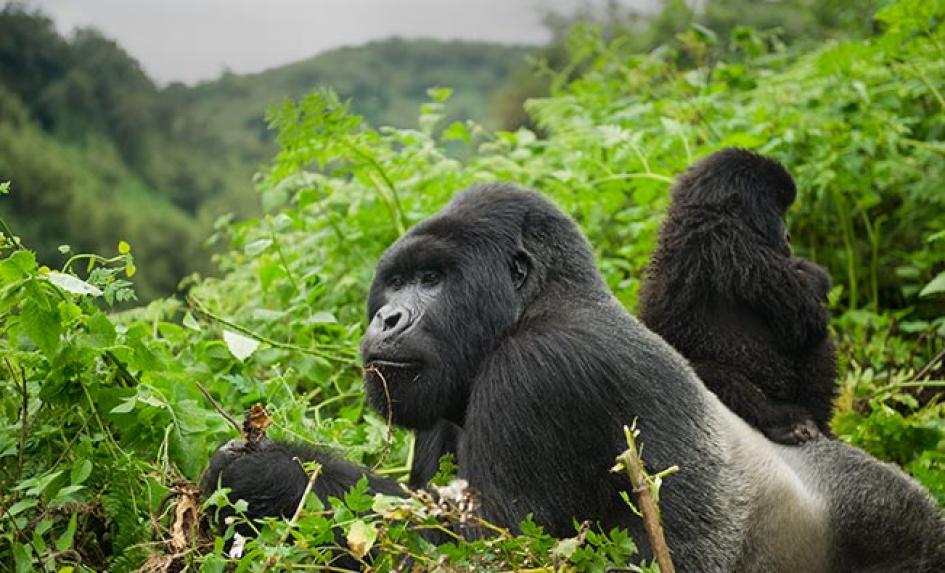
These giant Apes in Bwindi Impenetrable Forest are generally social creatures that live in groups/families of five to thirty individuals. These groups are normally made up of silverbacks (one dominant while others are subordinate), Adult females, blackbacks, sub-adult females, and infants. The Dominant silverback is territorial and jealously protects his family from being attacked or invaded by other mountain gorillas. The responsibility of caring for infants lies in the hands of both females and the dominant silverback through carrying, cuddling, and playing with them. The majority of the females eventually leave their natal group on reaching sexual maturity to join other groups and this is fundamental in preventing in-breeding tendencies among these Giant Apes.
Bwindi Gorillas don’t eat meat

Bwindi Gorillas are herbivores are therefore don’t eat meat but rather a vegetation that usually comprises bamboo shoots, leaves, stems, roots, tree barks, pith, wild celery, and rarely ants as well snails for their sodium content. An adult Bwindi Gorilla can eat up to 30 kilograms of vegetation in a single day.
Bwindi Gorillas have thick and long black fur
Bwindi Gorillas’ thick and long furs are helpful during temperature regulation and survival mechanisms in their natural habitats, which are primarily densely forested and misty mountains.
Bwindi Gorillas are no longer critically endangered
Appreciation goes to the combined conservation efforts of International Conservation Organizations, Government Agencies (UWA, RDB, and ICCN), tourists, and local communities to save the mountain gorillas whose population currently stands at 1063 individuals. For this reason, their threat level was elevated from “critically endangered” to simply “endangered”.
These extraordinary primates can live up to 40 years old
Gorillas are considered infants until three and a half years old and reach adulthood at 10 years for females and 13 years for males. Male gorillas between 8 and 12 years are considered blackbacks and thereafter begin developing silver-gray hair on the back as well as hips hence the name silverbacks.
Bwindi Gorillas are shy
Contrary to how they are portrayed, Bwindi Gorillas are very shy creatures and are habituated to make them less timid being in the presence of humans. They are also gentle and peaceful animals but will become aggressive when caught between a rock and a hard place. If threatened or challenged, they will roar and beat their chests to scare away their rivals and if it fails, they will fight back.
These Giant Apes are our close relatives
If you didn’t know, Bwindi Gorillas share at least 98.2% of DNA with us (mankind) and this implies that most diseases that affect them (especially communicable ones such as common colds, flu, tuberculosis, and measles) can affect them as well and therefore there is an urgent need to protect them from getting extinct.
Gorilla calls
Bwindi Gorillas produce over 16 different calls and these are made in varying situations. These calls are a complex combination of short barks, roars, and screams made to alarm other family members in case of danger or to intimidate their enemies. The silverback also beat chests and stomp their feet to intimidate rivals into withdrawing from any challenge.
Noseprints are used to identify Bwindi Gorillas
Like our fingerprints that have distinctive patterns, gorilla Noseprints also have exceptional patents thus no two gorillas have the same patterns.